Understanding Star Composition
In astronomy, understanding distant objects and what their properties are is somewhat of a mystery. Through new technology and experimentation, astronomers have been able to figure out how to calculate and figure out these “mysterious” facts about our solar system. One of the most influential things they have been able to figure out is the chemical composition of stars and how to determine it. Through many means, composition (the second most important factor in stars) can be determined. |  |
First off, we must understand what chemical composition is. Chemical composition is as straightforward as it sounds; it is merely what chemicals make something. In astronomy and nearly every science, the study of chemical composition is very prominent and definitely present. For the longest time, chemical composition of objects other than earth remained a mystery. Michael Richmond an astronomy professor explained that early scientists thought that the stars were probably similar to the Earth in chemical composition and attempted to find ways to figure out how. Many believed these scientists were crazy as these objects are trillions of miles away and there is no possible way we can be positive that our evidence is correct. Though we cannot physically travel to distant stars, cut out a chunk, and bring it back to earth; we can determine composition through the emission and absorption spectra it emits.
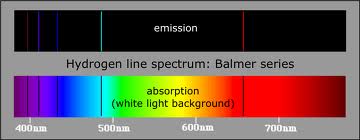 | Emission and absorption are one of the most fundamental ideas to understand when studying chemical composition. Like most things, it is important to understand what these ideas are before delving deeper into what they are. An absorption spectrum, according to Merriam-Webster dictionary, is an electromagnetic spectrum in which a decrease in intensity of radiation at specific wavelengths or ranges of wavelengths characteristic of an absorbing substance is manifested especially as a pattern of dark lines or bands. In other words, an absorption spectra deals with electrons being stolen from wave of light that a certain object gives off. |
On the contrary, an emission spectrum is when electrons get excited and let off waves that coordinate with a certain chemical. Through these two measurements, astronomers are able to determine what stars are made of by examining their spectrum. By looking at the lines on these spectrums they are able to see which chemicals are being absorbed or emitted and what the star is made of. One important aspect to understand about composition is that of metallacity. Metallacity is the amount of a star’s composition that is not Hydrogen or Helium; for example, the sun’s metallacity is 2%. This idea and process allows astronomers to determine where this star formed, about what time period, and using this knowledge, they are able to determine the environment and the chemicals that existed in this environment.
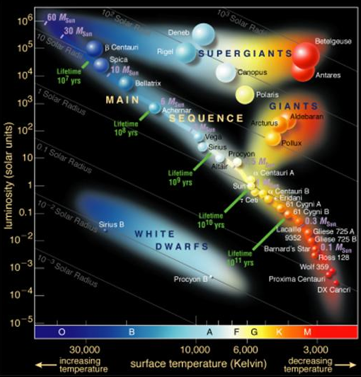
The next important process is where it lines up on the HR diagram. The HR diagram is how astronomers plot the stars according to where they are in their lifecycle. According to NASA, understanding the life of a star and what it goes through is a key factor in understanding composition. Through the HR diagram, it can be determined where in its lifetime a star is and what the core is currently going through. For example, if the star is on the main sequence (the middle diagonal line going from left top to bottom right) the star is currently fusing hydrogen in its core allowing us to see that there is definitely Hydrogen and Helium present in the star. Through looking at this diagram and exploring the light spectrum the star or object gives off, we are able to understand composition a bit better.
Though these processes are not the only ways to determine chemical composition, they are some of the most important aspects in astronomy and must be understood. Through chemical composition, astronomers are able to explore distant objects with more precise measurements. These processes will lead to the discovery of new material. Who knows what we might find next! Sources:
|  |
