What are Galaxies?
When people hear the word galaxy, there are many different explanations as to what they are; some say wide, big, and full of stars, and others explain they are “Wibbly wobbly timey wimey things” (popular British television series, Doctor Who). While these may be true and pend very popular beliefs, Cool Cosmos a NASA funded sight explains that galaxies are merely huge collections of stars, dust and gas. Galaxies contain several million to trillions of stars and range in size from few thousand to hundreds of thousands of light years in diameter. Most galaxies are a disk shape, though some are known as irregular, and most have a bulge, which is generally in the center. There are three major types of galaxies with some sub categories on the side. Each galaxy has a set of defined characteristics that help astronomers learn more about our universe.
The first and probably most well-known galaxy is a spiral galaxy. In spiral galaxies, the stars, gas and dust are gathered in spiral arms that protrude from the galaxy’s center (or the bulge). Stars form in certain parts of space where gas is compressed to form what we know as “arms.” These galaxies, since they have a lot of hot, young stars, are generally the brightest galaxies and appear blue in the night sky (blue indicates they are making new stars or active). Within the spiral category, there are three different types of galaxies; these types being a standard spiral galaxy, a barred spiral, or a lenticular galaxy. A standard spiral galaxy is a galaxy that is a disk shape, has arms, and consists of a spherical center bulge. | 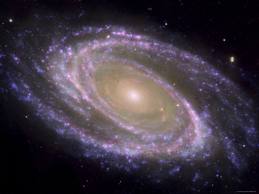 |
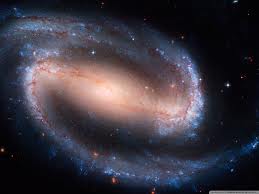 | The next type, barred spirals, are galaxies with an obvious disk, spiral arms, and an elongated bulge (Milky Way is this). The last type of spiral galaxies is a lenticular galaxy, unlike the others this galaxy does not have noticeable arms but is an obvious disk. The reason these are called spiral galaxies is because the rotation of the disk naturally make spiral arms and wind up over time. |
The next type of galaxy is an elliptical galaxy. According to NASA’s website for kids, elliptical galaxies are shaped like ellipses (stretched circles) and have very little star formation present. Elliptical galaxies come in many sizes, in fact, many of the biggest galaxies we have found are elliptical galaxies; however, these galaxies can also be very small. Unlike spiral galaxies, these galaxies appear yellow or red (red means there is little or no star formation occurring) and have low mass. Like spiral galaxies, there are multiple types of elliptical galaxies; these types being giant ellipses and dwarf ellipses. Giant ellipses are very straightforward in that they are giant elliptical galaxies. The second is as straightforward as the first meaning they are small elliptical galaxies with less than a billion stars, usually found near large spirals. Elliptical galaxies contain many stars; however, the orbit of stars is not organized, but they don’t collide.
The last type of galaxy is an irregular galaxy. Irregular galaxies have no particular shape and are among the smallest galaxies. These galaxies have a lot of gas and dust, meaning there is quite a bit of star formation going on in them. Although these galaxies were more common long ago, many are still being found throughout the universe, in fact, there are two very close to the Milky Way. On Enchanted Learning’s website they explain that irregular galaxies can be formed when galaxies collide or come close to one another and their gravitational forces interact. In all, understanding the different types of galaxies makes a subject that seems difficult and confusing become more exciting and fun to learn about. Like many things in astronomy, studying what something is helps one to not be so overwhelmed when learning new things. By understanding the different galaxy types, one becomes a knowledgeable citizen. | 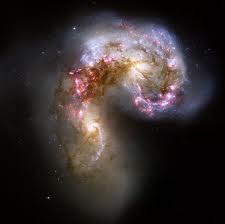 |
Works Cited:
- http://coolcosmos.ipac.caltech.edu/cosmic_kids/AskKids/irregular.shtml
- Class notes
